KNOWLEDGE EXCHANGE SPACE PAnel
Skills, Technology and Partnerships – Stalowa Wola in the European Debate on the Future of the Space Sector
Is the European education system keeping pace with advances in space technology? What specialists is the industry looking for today? Can companies outside the space sector become important players within it? How can industrial regions leverage their potential and compete effectively for talent?
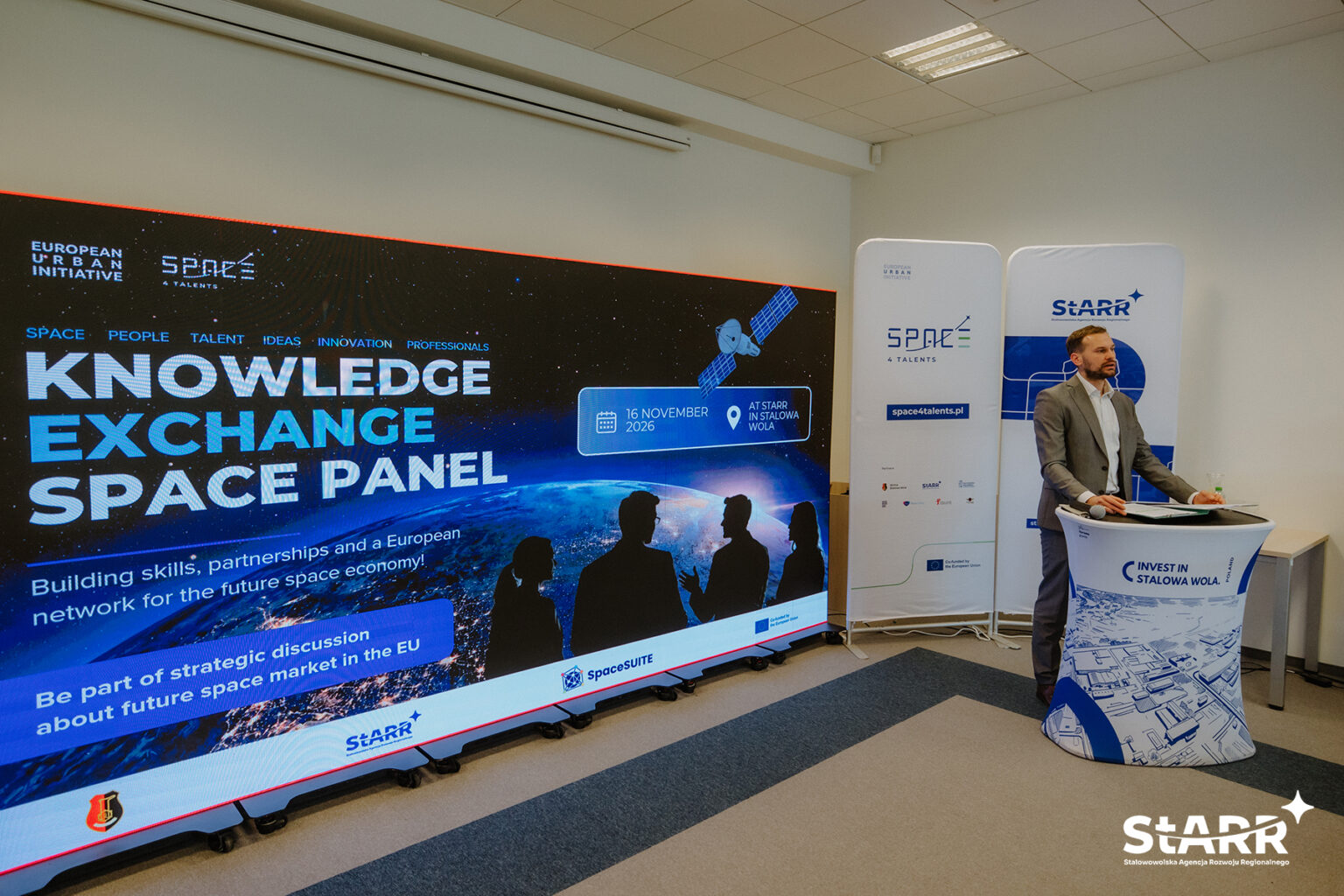
These questions were at the heart of the international event KNOWLEDGE EXCHANGE SPACE PANEL – Building Skills, Partnerships and a European Network for the Future Space Economy, held on 16 November 2026 at the headquarters of the Stalowa Wola Regional Development Agency (StARR).
Organised by StARR in cooperation with the European SpaceSUITE project, as part of the SPACE 4 TALENTS project, the event brought together representatives of European institutions, public administration, universities, research institutions, technology companies and organisations supporting the development of the space sector. The meeting was held in a hybrid format, in English, under the honorary patronage of the Polish Space Agency (POLSA).
Several hours of expert presentations, discussions and knowledge exchange provided an opportunity to explore the future of the European space sector from different perspectives – from early education, through industry needs and technology commercialisation, to European skills development policies and funding opportunities for international initiatives.
Space is much more than rockets and satellites
The event was opened by Jacek Śledziński, President of the Management Board of StARR, and Tomasz Miśko, Deputy Mayor of Stalowa Wola, who emphasised the importance of investing in human capital and the role of medium-sized cities in building the European space economy.
The keynote speech was delivered by Barbara Kwiatkowska-Mott, Senior Specialist in the Space Programmes Division, Department of Innovation and Space Policy, Ministry of Economic Development and Technology. She presented the strategic directions for the development of the Polish space sector, Poland’s involvement in European Space Agency programmes, the experience gained through the IGNIS mission, and the opportunities arising from the International Astronautical Congress (IAC 2027) to be held in Poznań. One of the key messages of her speech was that not every company needs to build satellites to become part of the space economy. The ability to use satellite data and services to develop solutions addressing the needs of agriculture, energy, transport, environmental protection, crisis management and public administration is becoming increasingly important. This perspective is particularly relevant to regions such as Stalowa Wola, which can develop new economic specialisations by building on their existing industrial and technological capabilities.
Barbara Kwiatkowska-Mott also emphasised that a competitive space sector cannot be built without a suitably skilled workforce. Infrastructure can be built and technology can be purchased, but developing skills, experience and the ability to innovate requires long-term investment in people.
What do we teach, and what does industry need?
Particularly interesting insights were provided by the presentation delivered by Martyna A. Stelmaszczuk-Górska from Friedrich Schiller University Jena and EO College, who presented the findings of research conducted within the SpaceSUITE project. A comparison of European education and training provision with the requirements outlined in job advertisements revealed significant discrepancies. In Earth observation, programming skills appeared in only 10% of the education and training offers analysed, compared with 22% of job advertisements. Even greater discrepancies were identified in satellite navigation, where transversal skills, such as communication and teamwork, appeared in 36% of job advertisements but only 10% of education and training offers. Similar gaps were identified in testing and verification skills. These findings demonstrate that, while European education programmes provide a solid theoretical foundation, employers are increasingly looking for people who can apply their knowledge in practice – programming, integrating systems, testing solutions and addressing real-world technological challenges.
Similar conclusions emerged from the ASTRAIOS project, whose results were presented by Mari Kolehmainen from the European Science Foundation. The project developed 28 recommendations for the further development of the European space sector, identifying skills shortages in areas including artificial intelligence, software engineering, data analysis, cybersecurity and systems engineering. Attention was also drawn to the uneven geographical distribution of educational and career opportunities across Europe, contributing to the migration of talent towards major technology hubs. Europe therefore needs more than simply an increase in the number of graduates in technical disciplines. Above all, it needs better alignment between their skills and changing economic realities.
From identifying gaps to developing solutions – how should education evolve?
The event showcased a range of European initiatives that not only identify skills gaps but also propose practical solutions. Carlo Cavicchioli from AZULchain presented the approach to micro-credentials being developed within SpaceSUITE, enabling individuals to demonstrate specific skills acquired through shorter, specialised learning programmes. Modular education programmes allow for faster responses to technological change while supporting the development of personalised career pathways.
Prof. Dorota Stadnicka from Rzeszów University of Technology, representing the AEROFUSE project, highlighted the need for greater industry involvement in designing education programmes, providing students with real-world technological challenges and engaging industry experts in assessing the solutions developed. Examples of cooperation with aerospace companies demonstrated how education can respond to specific industry needs.
Milva Carbonaro, SPACE4GEO Coordinator, presented opportunities for establishing regional skills partnerships under the European Pact for Skills initiative, drawing on examples of cooperation between Spain and Portugal.
Miriam Rosa from QSR, representing the COMPLEMENTS project, highlighted the potential for cooperation across the aerospace, defence, automotive and digital sectors.
Gabriela Opiła from AGH University of Krakow presented educational and international mobility opportunities offered by the UNIVERSEH European university alliance.
The session dedicated to European initiatives, moderated by Grazia Fiore from FDC and Space Y Association, provided valuable inspiration for the further development of the SPACE 4 TALENTS project, particularly its SPACE ACADEMY educational programme and cross-sector collaboration within the PENTAHELIX model.
From future skills to regional competitiveness
One of the key elements of the event was a two-part interactive roundtable discussion, moderated by Prof. Katarzyna Malinowska, Director of the Centre for Space Studies at Kozminski University. The discussion brought together:
- Grazia Fiore – representative of Space Y Association;
- Tomasz Zawistowski, PhD Eng. – Deputy Director for Technology Development at the Space Research Centre of the Polish Academy of Sciences (CBK PAN);
- Prof. Dorota Stadnicka – Professor at Rzeszów University of Technology, AEROFUSE project;
- Milva Carbonaro – SPACE4GEO Coordinator;
- Justyna Średzińska – Science Expert in Astrophysics, representative of ESERO-Poland, Copernicus Science Centre;
- Jacek Śledziński – President of the Management Board of the Stalowa Wola Regional Development Agency (StARR);
- Natalia Kobza – Director of R&D and Innovation Funding at CloudFerro S.A.;
- Monika Sitek – Business Development Specialist at Astronika, member of the Association of Polish Space Sector Professionals (PSPA);
- Weronika Gawęda – Head of the Industrial Competitiveness Section, National Contact Point Department, National Centre for Research and Development (NCBR).
The first part of the discussion focused on future skills and the changes needed within the education system. The second explored barriers, strategic choices and opportunities to leverage regional potential for the development of the space economy.
Bringing together perspectives from research, education, business and public administration led to several particularly interesting conclusions.
Practical experience cannot replace theory, but theory alone is not enough. A solid foundation in mathematics, physics and engineering remains essential. At the same time, future professionals must have opportunities to experiment, make mistakes and work on real-world projects before entering the labour market.
We cannot predict all the skills that will be needed in the next 10 to 15 years. Alongside specialised technical knowledge, it is therefore essential to develop the ability to learn, adapt, think critically, communicate and collaborate within interdisciplinary teams. In the age of artificial intelligence, the ability to independently assess and verify results is becoming particularly important.
Developing the future workforce begins long before university. The experience of ESERO-Poland demonstrated the importance of stimulating interest in science and technology at school level. Particular attention was paid to supporting teachers and providing young people with opportunities to interact directly with experts and explore real career pathways.
Cooperation between education and industry should be systematic rather than occasional. Proposed solutions included jointly designed education programmes, industrial PhDs, degree theses addressing business needs, the involvement of industry experts in teaching, and flexible forms of cooperation accessible to small and medium-sized enterprises.
Access to satellite data is no longer the main challenge. The challenge is creating value from it. Europe has vast resources of openly accessible satellite data. The key challenge today is transforming this data into products and services that customers are willing to pay for. Consequently, professionals who can combine technological expertise with an understanding of customer needs are becoming increasingly valuable.
Companies outside the space sector can become important players within it. Astronika’s experience and discussions on cross-sector cooperation demonstrated that capabilities in advanced manufacturing, electronics, automation, materials engineering and software development can provide an entry point into the space market for companies already established in other industries.
Attracting investors requires more than infrastructure and a skilled workforce. From a business perspective, market access and the ability to secure an initial anchor customer are also essential. Building a regional technology ecosystem should therefore involve not only developing skills and infrastructure but also stimulating demand for innovative solutions.
What does this mean for Stalowa Wola?
One of the fundamental challenges facing regions developing new economic specialisations is breaking the cycle in which companies seek locations with access to skilled workers, while workers choose places where attractive employment opportunities already exist. This challenge was also addressed by Jacek Śledziński during his presentation of the SPACE 4 TALENTS project. Its three pillars: SPACELAB, SPACE ACADEMY and PENTAHELIX COOPERATION, are designed to simultaneously develop skills, technological infrastructure, entrepreneurship and cross-sector collaboration.
The findings of European research and the experiences shared during the event highlighted the need to develop education programmes jointly with businesses, expand internship, work placement and mentoring opportunities, support teachers, and facilitate the upskilling and reskilling of employees in existing industrial sectors.
The Knowledge Exchange Space Panel demonstrated that Stalowa Wola is not alone in seeking answers to these challenges. Many European regions face similar issues, and cooperation enables them to benefit from existing solutions rather than having to develop them from scratch.
European partnerships and funding opportunities
The discussions were complemented by presentations delivered by Leïla Ajjabou from the European Union Agency for the Space Programme (EUSPA) and Weronika Gawęda from the National Centre for Research and Development (NCBR), focusing on European initiatives and funding opportunities for the development of the space sector. As highlighted during the NCBR presentation, three calls covering eight space-related topics are planned under Horizon Europe for 2027, with a combined budget exceeding EUR 88 million and an expected 18 projects to be funded. The emerging directions of the EU’s post-2027 financial framework were also discussed, alongside the growing importance of cooperation between the space, defence, digital and industrial sectors.
At the same time, attention was drawn to increasing competition for European funding. Access to funding alone does not guarantee success. Equally important are the quality of project ideas, the experience of partners and the ability to build strong international consortia.
From knowledge exchange to joint action
One of the most important messages emerging from the event was the need to move beyond further analysis of skills gaps towards the practical implementation of solutions.
Europe already has a substantial body of knowledge about the needs of the space sector. The challenge now is to translate this knowledge into effective education programmes, new models of cooperation with industry, and initiatives that deliver tangible results at regional level.
The Knowledge Exchange Space Panel therefore does not end with the meeting in Stalowa Wola. It provides a starting point for further cooperation, the exchange of educational resources and the development of joint project initiatives. The event will be followed by online working sessions with interested partners, aimed at identifying concrete opportunities for collaboration.
A special highlight of the event was a performance by Korean crossover cellist Na-Young Lee, bringing together the worlds of science, technology and art.
We would like to extend our sincere thanks to all speakers, panellists, moderators and participants for an exceptionally valuable exchange of knowledge, experience and perspectives, and to the SpaceSUITE project team for co-organising the event.
Presentations and downloadable materials
We invite you to explore the materials prepared by the experts participating in the Knowledge Exchange Space Panel, showcasing European research findings, good practices, innovative approaches to skills development, and opportunities for cooperation and funding within the space sector.
- Barbara Kwiatkowska-Mott – Download PDF presentation
- Jacek Śledziński – Download PDF presentation
- Milva Carbonaro – Download PDF presentation
- Martyna A. Stelmaszczuk-Górska – Download PDF presentation
- Carlo Cavicchioli – Download PDF presentation
- Mari Kolehmainen – Download PDF presentation
- Miriam Rosa – Download PDF presentation
- Gabriela Opiła – Download PDF presentation
- Leïla Ajjabou – Download PDF presentation
- Weronika Gawęda – Download PDF presentation
The event was organised as part of the SPACE 4 TALENTS project, co-funded by the European Urban Initiative – Innovative Actions (EUI-IA), in cooperation with the SpaceSUITE project, under the honorary patronage of Polish Space Agency (POLSA).
Udostępnij:
Inne aktualności
Kompetencje dla sektora kosmicznego. Europejscy eksperci spotkali się w Stalowej Woli
Jak rozwijać kompetencje kosmiczne i przygotować młodych ludzi do pracy w branży? O tym rozmawiali eksperci z Polski i zagranicy podczas Knowledge Exchange Space Panel w Stalowej Woli, który odbył się 16 listopada 2026 r. w siedzibie Stalowowolskiej Agencji Rozwoju Regionalnego (StARR). W programie znalazły się prezentacja projektu SPACE 4 TALENTS, debata o potrzebach szkoleniowych europejskiego sektora kosmicznego oraz warsztaty, podczas których uczestnicy opracowywali pomysły na wspólne projekty. Wydarzenie odbyło się pod honorowym patronatem Polskiej Agencji Kosmicznej (POLSA).

Kosmiczna energia młodych talentów w Stalowej Woli! NASA Space Apps Challenge 2026 za nami.
241 uczestników, w tym blisko jedna trzecia z naszego regionu, przez dwa dni pracowało nad wyzwaniami NASA, korzystając z otwartych danych agencji i jej partnerów. W finale jury wyłoniło laureatów w kategoriach technologicznej i artystycznej. Łączna pula nagród wyniosła 20 000 zł. Poznaj zwycięzców i wyróżnione zespoły oraz zobacz zdjęcia z wydarzenia.
Stalowa Wola czerpie z doświadczeń Coimbry. Wspólna praca nad rozwojem innowacji i technologii kosmicznych
Przedstawiciele projektu SPACE 4 TALENTS uczestniczyli w Deep Tech CEE Summit & Challenge, wydarzeniu poświęconym innowacjom, sztucznej inteligencji, technologiom kosmicznym oraz rozwojowi kompetencji przyszłości.
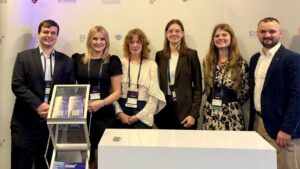
SPACE 4 TALENTS na Deep Tech CEE Summit. Stalowa Wola w centrum rozmów o technologiach przyszłości
Przedstawiciele projektu SPACE 4 TALENTS uczestniczyli w Deep Tech CEE Summit & Challenge, wydarzeniu poświęconym innowacjom, sztucznej inteligencji, technologiom kosmicznym oraz rozwojowi kompetencji przyszłości.